
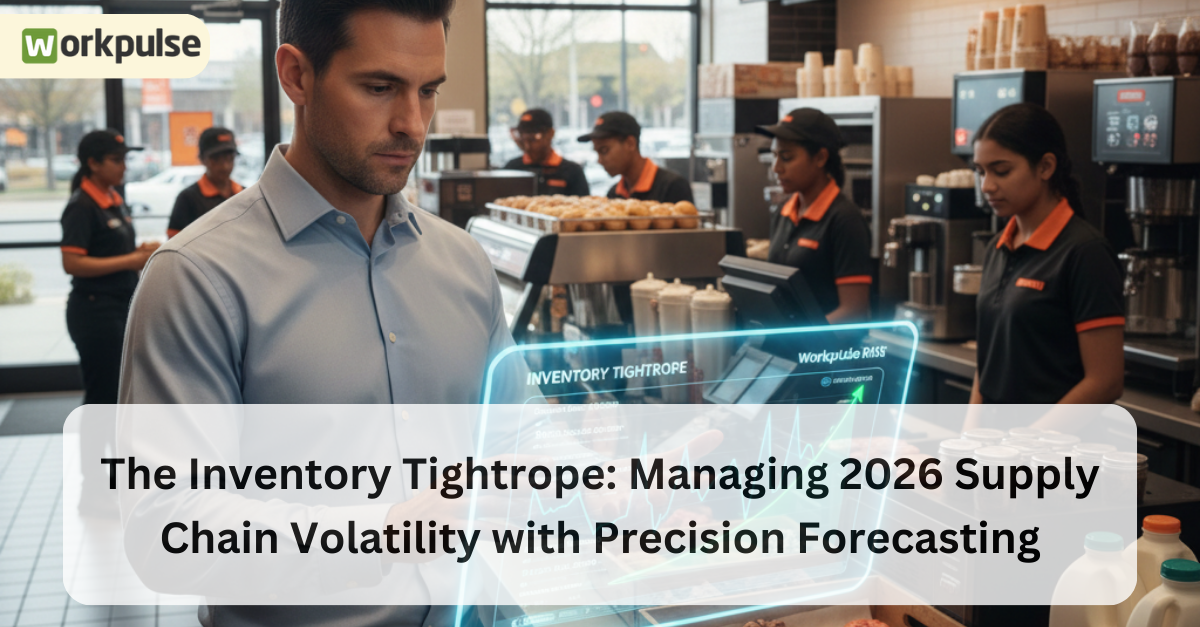
It’s a Tuesday morning in early February 2026. Your morning manager opens the walk-in only to find that despite “ordering heavy” on Friday, you are down to your last three gallons of oat milk. By 8:00 AM, your highest-margin latte orders are being cancelled, and your drive-thru line is backing up as crew members explain the shortage to frustrated guests.
For the 2026 Dunkin’ franchisee, this isn’t just a minor inconvenience—it’s a financial hemorrhage. In an era where “Just-in-Time” logistics have been shattered by climate-driven crop failures and unpredictable labor spikes at regional distribution centers, the old way of ordering (looking at what you used last week and adding 10%) is no longer a strategy. It’s a gamble.
We call this the “Inventory Tightrope.” Lean too far into overstocking to avoid outages, and you’re tying up thousands of dollars in “dead stock” that will eventually end up in a dumpster. Lean too far into “lean operations,” and you lose the digital guest who has zero patience for a “Sold Out” notification on their app.
In 2026, the margin for error has vanished. To stay profitable, operators must move beyond manual counts and “gut feelings.” You need Precision Forecasting—the ability to sense demand before it happens and align your supply chain with the reality of the modern market.
The 2026 Volatility Factors: Why Your 2023 Playbook is Broken
If you are still ordering based on “what we did last year,” you are likely already behind. In 2026, the historical data that used to be the bedrock of QSR operations has been destabilized by two primary forces: Climate-Driven Supply Shocks and Digital Viral Surges.
Climate-Driven Stockouts: The “Green-flation” Reality By early 2026, the “Cocoa Crisis of ’25” has become a case study in fragility. Unpredictable weather patterns in West Africa and Central America have made high-demand items—like mocha swirls and coffee beans—subject to sudden, 30% price spikes or regional “allocation only” status.
Traditional ordering systems are “reactive”; they wait for you to run out before suggesting more. But when a polar vortex hits the Midwest, driving dairy prices up and slowing delivery trucks, a reactive system leaves you empty-handed. In 2026, you need a system that tracks these macro-trends and adjusts your “Safety Stock” levels before the logistics chain snaps.
The “Viral Surge” Variable The “TikTok Menu” is now a permanent operational hazard. In 2026, a local influencer with 50,000 followers can post a video of a “secret” hack—like a Lavender Iced Chai with a specific cold foam—and by noon, your store has sold a week’s worth of lavender syrup.
A manual “par level” can’t account for a 400% demand spike triggered by a smartphone. Without a system that monitors real-time sales velocity and flags these anomalies, your manager won’t realize they are in trouble until the last bottle is empty.
The Opportunity Cost Stat The financial stakes are higher than ever. 2026 industry benchmarks show that for every 1% decrease in food waste achieved through better forecasting, a franchisee sees an average 2.5% increase in net profit. In an environment where labor and rent are fixed, non-negotiable costs, your inventory is the only “lever” left to pull to protect your bottom line.
The “Dead Capital” Trap It isn’t just about being out of stock; it’s about being “over-stocked” on the wrong things. Inventory sitting on your shelves is “Dead Capital”—cash that isn’t in your bank account to cover the $18/hour entry-level wages required in 2026. Precision forecasting ensures that your cash is “liquid,” sitting in your bank rather than expiring in a walk-in cooler.
The True Cost of “Being Out”: Beyond the Missing Donut
In 2026, an out-of-stock item is rarely just a “lost sale.” It is a catastrophic event for your store’s digital reputation and operational flow. In a hyper-connected QSR market, the cost of being out of an ingredient has tripled because the penalty is no longer just local—it is algorithmic and psychological.
The “Brand Defection” Stat: The Two-Strike Rule Data from 2026 consumer behavior studies shows that brand loyalty has become incredibly fragile. Today, 68% of QSR guests state that if their “Mobile Order” is unavailable or cancelled twice in a single month, they will delete the app and switch to a competitor permanently. In the 2026 mindset, a stockout isn’t viewed as a “supply chain issue”; it is viewed as a “management failure.” When a guest can’t get their specific morning ritual, they don’t just wait for tomorrow—they find a new ritual elsewhere.
The “Delivery Platform” Shadow Ban For the modern Dunkin’ franchisee, third-party delivery (DoorDash, UberEats, etc.) can account for up to 30% of revenue. However, in 2026, these platforms have integrated “Inventory Reliability” directly into their search algorithms.
- The Penalty: If your store frequently marks items as “unavailable” or has a high rate of order cancellations due to stockouts, the platform’s AI “shadow bans” your store, dropping your search ranking to the second or third page.
- The Result: You lose “digital foot traffic” you didn’t even know you had. A stockout of oat milk doesn’t just lose you a latte sale; it lowers your visibility for every other item on your menu.
“Apology Fatigue”: The Hidden Driver of Turnover In 2026, the labor market remains a primary headache. One of the most cited reasons for “Shift Burnout” among Gen Z and Alpha crews is Apology Fatigue. Employees don’t quit because the work is hard; they quit because they are tired of being the “bearer of bad news” to 200 frustrated customers a day.
- The Impact: When a store is consistently out of core items, the friction between the crew and the guests increases. This toxic environment leads to a 15-20% higher turnover rate in poorly forecasted stores. Precision inventory isn’t just a financial tool—it’s a morale tool. Keeping your shelves full keeps your crew from walking out the door.
The “Vibe” Judgement A final 2026 reality: 43% of shoppers now judge a store’s “vibe” and reliability based on visual cues of abundance. A half-empty donut case or a “Sold Out” sign taped to a kiosk doesn’t just signal a lack of product; it signals a store in decline. In an era where “experience” is the product, an empty shelf is a brand-killer.
Leveraging Workpulse RMS for “Demand Sensing”
By 2026, the industry has shifted from traditional “demand forecasting”—which looks at what you did in the past—to “Demand Sensing.” While forecasting tells you what to expect based on last February, demand sensing uses real-time data to tell you what is happening right now. Workpulse RMS acts as the central nervous system for your Dunkin’ franchise, pulling in signals that no manual spreadsheet could ever track.
From History to Prediction Historical data is a valuable baseline, but it’s often “blind” to current anomalies. If a local high school moves its graduation ceremony or a nearby tech hub suddenly shifts to a “return to office” mandate, your 2025 sales data becomes irrelevant. Workpulse RMS uses Machine Learning to detect short-term shifts in consumer behavior, reducing forecast errors by 20% to 50%. It doesn’t just look at what you sold; it looks at the velocity of sales during the first two hours of your shift to predict the next six.
The “Smart Suggested Order”: Automating the “Sweet Spot” The most stressful part of a manager’s day is the 3:00 PM inventory order. They are tired, the lobby is busy, and they are essentially “guessing” how many cases of cream cheese they need for the weekend.
- The RMS Solution: The system generates a Smart Suggested Order by cross-referencing live inventory levels with projected demand. It calculates the “Sweet Spot”—just enough safety stock to handle a 2026 “Viral Surge,” but not so much that you’re throwing away expired product on Monday morning.
External Signal Integration: Managing the “Micro-Climates” In 2026, weather isn’t just a conversation starter; it’s a demand driver.
- Hyper-Localized Data: Workpulse RMS can integrate with local weather feeds to anticipate “Micro-Climate” shifts. If a sudden rainstorm is predicted for tomorrow morning, the system knows that “Munchkins” and “Hot Coffee” sales will spike while “Iced Refreshers” will dip.
- The Result: The system automatically nudges the suggested order to reflect these shifts. You don’t need to be a meteorologist to run a profitable Dunkin’; you just need a system that listens to the sky.
The “Delivery Sync” Advantage With delivery representing nearly a third of QSR revenue in 2026, your “Demand Sensing” must include digital signals. Workpulse RMS monitors your delivery aggregator feeds (DoorDash, UberEats) to identify if certain items are trending higher in your specific zip code. If the “Sourdough Breakfast Sandwich” is suddenly the top-ordered item in your neighborhood, RMS flags the potential bread shortage before your morning crew even realizes they are low.
Operational Excellence: The Actual vs. Ideal (AvI) Bridge
In the razor-thin margins of 2026, many Dunkin’ franchisees mistakenly believe their biggest inventory cost is “being out of stock.” In reality, the most dangerous drain on your bank account is the “Invisible Variance”—the gap between what you should have used based on your sales and what is actually gone from your shelves.
Identifying the “Invisible Waste” Actual vs. Ideal (AvI) reporting is the definitive tool for 2026 operational discipline.
- The Ideal: Your POS records show you sold 400 iced lattes. Based on your standard recipe, you should have used exactly 50 gallons of milk.
- The Actual: Your inventory count shows 58 gallons are missing.
- The Gap: Those 8 “phantom” gallons represent pure profit vanishing into the floor drains. Without an AvI bridge, this loss is often misdiagnosed as a “supplier shortage” or simply “high food costs.” In reality, it’s a failure of portion control, unauthorized comps, or internal “sweethearting.”
Portion Control in a High-Cost World In 2026, with 82% of restaurateurs expecting food costs to continue climbing, a “heavy hand” at the flavor station is a financial liability. A crew member adding an extra pump of swirl to every cup may seem like “good service,” but across 1,000 transactions a day, that “generosity” can cost a single store over $1,200 a month in unearned product usage. By using Workpulse RMS to track these variances daily rather than monthly, you can identify which shift—or even which specific team member—is struggling with recipe compliance before the waste becomes a habit.
The “Inventory Fraud” Factor The National Restaurant Association estimates that internal theft and “paper waste” (marking items as wasted when they were actually taken) can eat up to 7% of total sales in a QSR environment. 2026’s younger crews are tech-savvy; they know how to manipulate manual logs. AvI reporting removes the “human element” from this equation. When the system automatically flags that your “AvI Gap” for high-cost items like protein or premium syrups has spiked by 5%, it creates an immediate audit trail that protects your store’s integrity.
Case Study: The “Cheese-Slice” Miracle A 12-unit operator recently discovered a 4% variance in their sliced cheese usage. Through Workpulse RMS, they realized it wasn’t a theft issue—it was a training issue. During the morning rush, the crew was accidentally pulling two slices instead of one because the brand’s new packaging made the slices stick together.
- The Result: By adjusting the prep method and monitoring the AvI daily, the operator saved $45,000 in six months across their network. That is the power of precision over guesswork.
Mastering the Balance
The “Inventory Tightrope” of 2026 is no longer a challenge you can solve with a clipboard and a decade of experience. In an era where a single viral post can empty your shelves and a regional weather event can spike your costs overnight, the old ways of “guess-and-check” ordering are the fastest route to a failing P&L.
The Summary: Precision Over Panic Mastering your 2026 supply chain means moving from a reactive state to a predictive one. By leveraging Workpulse RMS, you aren’t just managing boxes; you’re managing peace of mind.
- You eliminate the 5 AM “milk run” panic.
- You stop the “apology fatigue” that burns out your best crew members.
- You turn “dead capital” on your shelves back into liquid cash in your bank.
The Final Thought: A New Operational Standard Precision forecasting doesn’t just protect your donuts; it protects your Brand Promise. When a guest in 2026 pulls up their app to order their morning ritual, they aren’t looking for an excuse—they are looking for consistency. Operators who embrace “Demand Sensing” and bridge the AvI gap are the ones who will dominate the 2026 market. They aren’t just “surviving the chaos”—they are profiting from the precision.
The Mandate for 2026 Don’t let your margins be dictated by a volatile supply chain or a “gut feeling.” It’s time to stop walking the tightrope and start standing on the solid ground of data.
Stop guessing. Start sensing. Secure your 2026 growth with Workpulse RMS.