
The 9 PM Post-Mortem: A Ritual of the Past
It’s 9:15 PM on a Tuesday. The drive-thru lights are dimmed, the last rack of donuts has been cleared, and your Shift Lead is hunched over the back-office desk, squinting at a long, curling strip of thermal paper: the Z-tape. After twenty minutes of clicking a calculator and shuffling “Paid Out” slips, the verdict is in—the drawer is $28.40 short.
In the “Old Way” of QSR management, this was just the cost of doing business. You’d sigh, make a note in a dusty binder, and promise to “talk to the crew tomorrow.” But in 2026, “tomorrow” is too late.
With labor costs hitting historic highs and food inflation squeezing every cent out of a glazed donut, the $20 discrepancy isn’t just a rounding error—it’s a symptom of a much larger management failure. For the modern Dunkin’ franchisee, the Z-tape is a post-mortem; it tells you why the patient died, but it does nothing to save the life of your margins during the shift.
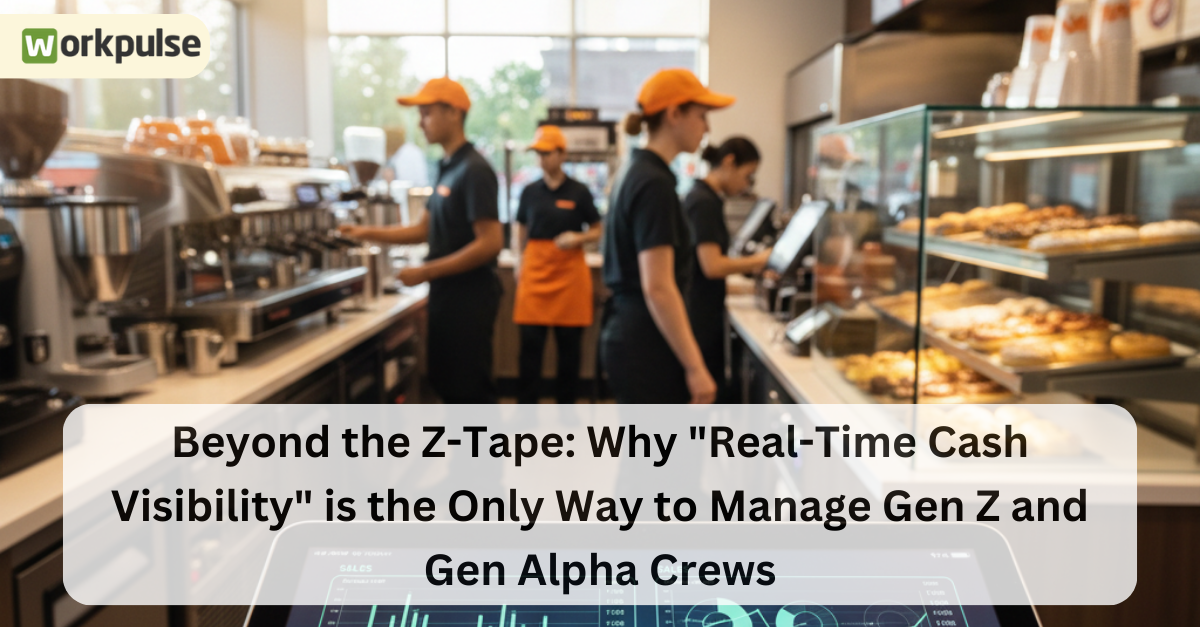
Managing the newest wave of talent—Gen Z and the emerging Gen Alpha—requires a fundamental shift in how we handle the register. They don’t want to be interrogated about a mistake that happened eight hours ago. They thrive on transparency, instant feedback, and digital proof. To lead them effectively, we have to move Beyond the Z-Tape and into the era of Real-Time Cash Visibility.
The Psychology of the 2026 Crew: Why “Instant” is Non-Negotiable
In 2026, the QSR workforce is dominated by Gen Z and the rising Gen Alpha—digital natives who have never known a world without a smartphone in their pocket. To these employees, the concept of a “delayed review” is an alien concept. If they order a package, they track it in real-time; if they post a photo, they see likes instantly. When this “Push Notification” generation enters your Dunkin’ lobby, their expectation for feedback doesn’t change.
The “Feedback Loop” Expectable For an 18-year-old crew member, a cash discrepancy discovered at 9 PM for a mistake made at 10 AM feels like a lifetime ago. Psychology shows that for this demographic, the effectiveness of a “correction” drops by nearly 60% if it occurs more than four hours after the event. By the time you sit them down the next day to discuss a “short drawer,” the memory of the transaction is gone, and the conversation feels like an accusation rather than a coaching moment.
Accountability vs. Ambiguity Contrary to the “slacker” stereotype, research into the 2026 labor market suggests that 72% of Gen Z workers actually prefer high-frequency, data-driven feedback. They thrive in environments where the “rules of the game” are visible. When cash visibility is “blind”—meaning only the manager sees the numbers once a day—it creates a culture of ambiguity. Ambiguity leads to anxiety, and anxiety leads to turnover.
Case Study: The “No Sale” Intervention Consider a common scenario: A crew member hits “No Sale” to make change for a guest, but the system flags a pattern of three “No Sales” within a twenty-minute window.
- The Old Way: You find out at the end of the week, suspicious but unable to prove intent.
- The 2026 Way: Workpulse RMS sends a real-time alert. You walk onto the floor and ask, “Hey, I noticed the drawer was opened three times for no-sales; are we having trouble with the bill changer?”
This isn’t an interrogation; it’s Active Oversight. It shows the crew that the system is “watching” in real-time, which ironically makes them feel more secure. It removes the temptation to “test the fences” and replaces it with the comfort of clear, immediate boundaries. In 2026, transparency isn’t “Big Brother”—it’s the only language the new workforce speaks fluently.
The “Integrity Leak”: The Hidden Cost of the Blind Shift
In a high-volume Dunkin’ environment, profit isn’t usually lost in one large heist; it bleeds out in “micro-transactions.” In 2026, with the average net profit margin for QSRs hovering between 5% and 8%, a franchisee cannot afford an “integrity leak.” When you lack real-time visibility, you aren’t just missing cash—you are missing the red flags that signal your margins are under attack from within.
The “Sweethearting” Epidemic and the “Cash-and-Delete” Real-world loss prevention data in 2026 shows that “Sweethearting”—giving away free food or discounts to friends and family—accounts for nearly 35% of all internal retail shrinkage. Without live monitoring, a crew member can easily hand out a half-dozen donuts, “forget” to ring them up, or ring them up and immediately hit “Delete” or “Void” after the guest walks away with the receipt. If you are only looking at the Z-tape at night, those voids look like simple mistakes. In reality, they are untraced revenue exits.
The $2,500 Drain: The Math of “Small” Losses Franchisees often shrug off a $5 or $10 shortage as “human error.” But let’s look at the 2026 math for a standard 5-store network:
- Average Daily Leak: $7 per shift (2 shifts per day).
- Daily Total: $14 per store.
- Monthly Total (5 stores): $2,100.
- Annual Impact: $25,200.
That is $25,000 of pure bottom-line profit—roughly the cost of a new espresso suite or a significant portion of a store’s annual maintenance budget—vanishing because of “blind shifts.” When visibility is delayed, these small leaks become part of the store’s “culture.”
The “Trust but Verify” Paradox There is a psychological phenomenon in QSR management: Opportunity creates the thief. When Gen Z and Alpha crews perceive that the “system” is slow, glitchy, or unmonitored, the barrier to “testing the fences” drops. However, when a system like Workpulse RMS is in place, the “Opportunity” is removed. Real-time visibility actually protects your honest employees. It ensures they aren’t painted with the same brush of suspicion when a drawer comes up short, as the data can pinpoint exactly which transaction—and which biometric login—caused the variance. In 2026, protecting your cash is protecting your culture.
Leveraging Workpulse RMS for “Active Oversight”
To manage a Dunkin’ in 2026, you need more than a record of what happened; you need a dashboard of what is happening. Workpulse RMS transforms cash management from a “back-office chore” into a “front-of-house strategy” by providing what we call Active Oversight.
Live POS-to-RMS Syncing: The End of the “Night Shift Scramble” The most immediate benefit of 2026 technology is the death of manual entry. Traditionally, a manager would spend 45 minutes at the end of every day reconciling paper receipts against POS reports. With Workpulse RMS, the POS data is “live-synced.” This means the system is constantly comparing actual cash-in-drawer expectations against real-time sales. If a Shift Lead performs a mid-day “cash drop,” the system updates instantly. No more “Late Night Reconciliation Marathons”—just a clean, digital audit trail that is ready whenever you are.
The “Red Flag” Intelligence System Workpulse RMS doesn’t just show you numbers; it shows you patterns. In 2026, the software uses “Exception Reporting” to highlight high-risk behaviors that often bypass the human eye:
- Post-Total Voids: When a transaction is totaled but then voided after the guest has left.
- The “Open Drawer” Frequency: Identifying if the drawer is being opened more often than there are transactions (a classic sign of “making change” outside the system).
- Excessive Deletes: Flagging crew members who delete high-margin items (like Nitro Cold Brews or Breakfast Sandwiches) at a rate 20% higher than the store average.
Objective Leadership: Removing the “Guts and Feelings” One of the hardest parts of managing Gen Z and Alpha is the “emotional” side of accountability. When a manager says, “I feel like you’re giving away too much free food,” it feels like a personal attack.
When a manager pulls up the Workpulse RMS Dashboard and says, “The data shows 15 voids on your login during the 8 AM rush, while the rest of the team averaged two,” the conversation changes. It is no longer about the person; it is about the objective data. This transparency allows for a “coaching-first” culture where the manager uses the dashboard to help the employee improve, rather than catching them in a lie. In 2026, leading with data is the only way to maintain the high-trust environment your best employees crave.
Scaling the “Gold Standard”: Multi-Unit Management in 2026
For the multi-unit Dunkin’ franchisee, the challenge of cash management isn’t just about one drawer—it’s about the “visibility gap” that grows with every new rooftop. When you own ten stores, you can’t be present for ten Z-tape reconciliations. In 2026, managing a portfolio requires shifting from being a “store watcher” to a “data conductor.”
The “Remote Command Center” In 2026, top-tier operators manage their businesses through a “Remote Command Center” approach. Using Workpulse RMS, a franchisee can be in their home office in Florida while virtually “standing behind the counter” of their store in New York.
- The Reality: You don’t need to wait for a phone call about a shortage. Your dashboard aggregates live data across all locations, ranking stores by “Cash Integrity.”
- The Impact: If Store A has a $2 variance and Store B has a $40 variance, your attention is automatically triaged to the outlier. This “Management by Exception” saves hours of unnecessary travel and phone calls, allowing you to focus only where the “fire” is actually burning.
Gamifying Accuracy: Linking RMS to WOW One of the most innovative shifts in 2026 is the integration of cash data with employee rewards. By linking Workpulse RMS with the Workpulse WOW module, franchisees are turning “boring” compliance into a competitive game for Gen Z and Alpha.
- The “Perfect Drawer” Badge: Instead of only talking to employees when they are short, the system automatically triggers a “WOW” shoutout or a digital badge when a crew member hits a “Perfect Drawer” (zero variance) for five consecutive shifts.
- The Result: This flips the script on cash management. It’s no longer about “not stealing”; it’s about “winning.” In an industry where 90% of employees say gamification makes them more productive, rewarding accuracy creates a self-policing culture where the crew takes pride in their precision.
The 12% COGS Reduction Industry data from 2026 shows that QSR locations implementing real-time cash transparency see an average 12% reduction in overall COGS (Cost of Goods Sold). This isn’t just because theft stops; it’s because operational discipline improves. When the crew knows the cash is tracked in real-time, they tend to be more precise with portions, more careful with waste, and more diligent with the POS. In 2026, a “clean” drawer is the leading indicator of a “clean” (and profitable) kitchen.
The New Leadership Mandate
The Z-tape is a relic of a slower era—a time when “finding out tomorrow” was acceptable because margins were wider and the workforce was more patient. In 2026, those days are gone. Managing a Dunkin’ franchise today requires a leadership style that is as fast and transparent as the technology we use to serve our guests.
From “Watching the Money” to “Empowering the Person” Real-time cash visibility through Workpulse RMS isn’t just about protecting your bank deposit; it’s about protecting your people. By removing the “gray areas” of shift reconciliation, you create a workplace where honesty is verified, effort is recognized, and mistakes are caught early enough to be corrected. For Gen Z and Gen Alpha, this clarity is the foundation of trust. They don’t want to work for a “detective”; they want to work for a “coach” who has the data to help them succeed.
The Bottom Line: Precision is Profit As we’ve seen, the “Integrity Leak” is a silent killer of QSR profitability. A $25,000 annual loss across a small network is the difference between a struggling store and one that has the capital to reinvest in the latest equipment or higher-tier talent. In the 2026 landscape, you cannot manage what you cannot see.
The choice for the modern franchisee is clear: continue with the reactive, high-stress ritual of the “9 PM Post-Mortem,” or embrace the proactive power of Active Oversight. It’s time to stop looking at the past through a thermal paper tape and start looking at your future through a real-time dashboard.
Ready to see what your stores are doing right now? Upgrade to Workpulse RMS and bring your cash management into 2026.